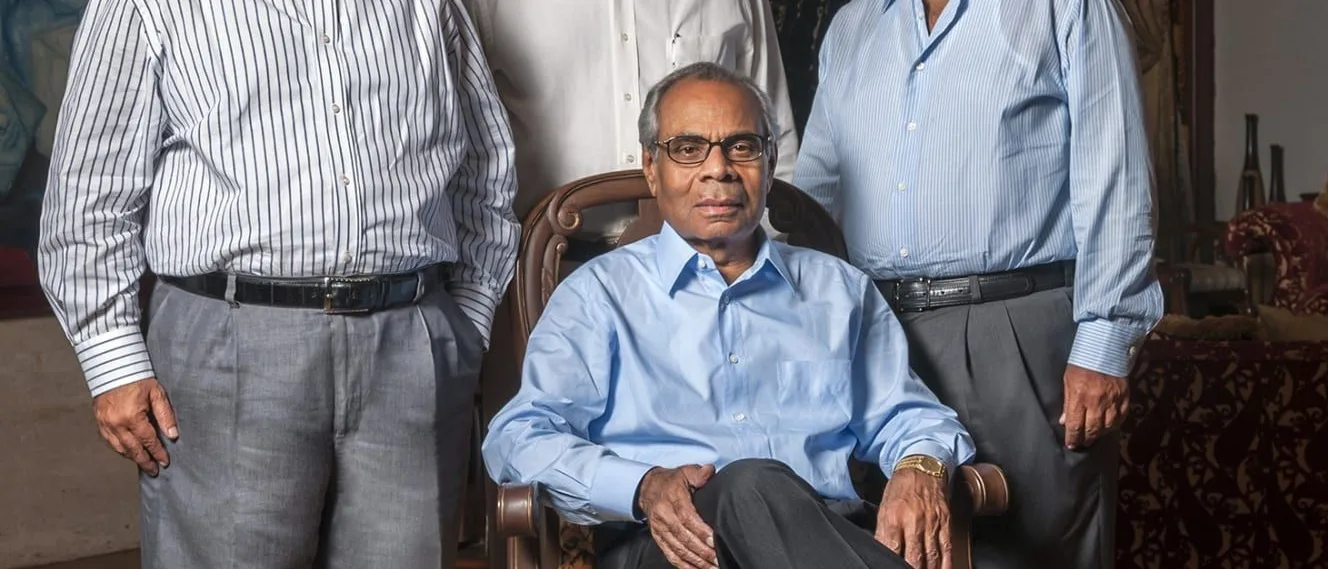
The Hinduja family owns everything and nothing at the same time. That is not a riddle. It is the actual philosophy -- "everything belongs to everyone and nothing belongs to anyone" -- that once held together a $33 billion empire spanning 40 countries, anchored by heavyweights like IndusInd Bank and commercial vehicle giant Ashok Leyland. It is also the phrase that would eventually blow the whole thing apart in a London courtroom. Britain's wealthiest family did not need enemies. They had each other.
At the storm's center stood Srichand Hinduja, the eldest of four brothers and the patriarch whose steady hand had guided the group to global dominance. When dementia began dismantling his mind in the early 2010s, it did not just remove a leader from the boardroom. It detonated a succession crisis that exposed every fault line the family had spent decades papering over. A 2022 court settlement brought a brief ceasefire. Then Srichand died in 2023, and the war started all over again.
From Sindh traders to a global dynasty
The Hinduja story begins in the early 20th century in Sindh, then part of British India and now Pakistan, where Parmanand Deepchand Hinduja built a trading operation linking India, Iran, and Iraq. It was scrappy, ambitious, cross-border commerce -- the kind of hustle that scales.
And scale it did. Over the following decades, the Hinduja Group ballooned into a conglomerate touching banking, finance, energy, automotive manufacturing, healthcare, and media across multiple continents. IndusInd Bank became one of India's largest private sector banks. Ashok Leyland grew into a major manufacturer of commercial vehicles. Gulf Oil added petroleum muscle. The four brothers running the show -- Srichand, Gopichand, Prakash, and Ashok -- were celebrated as a model of sibling cooperation, a unit so tight they governed the entire operation under that shared mantra: everything belongs to everyone and nothing belongs to anyone.
For years, the system worked. Joint decisions, shared profits, a single organism moving in lockstep. But philosophies built for a scrappy trading house do not always survive the pressures of a multinational juggernaut, aging founders, and a next generation hungry for their own seat at the table. As the brothers grew older and Srichand's health started its slow collapse, the cracks did not just appear. They widened fast.
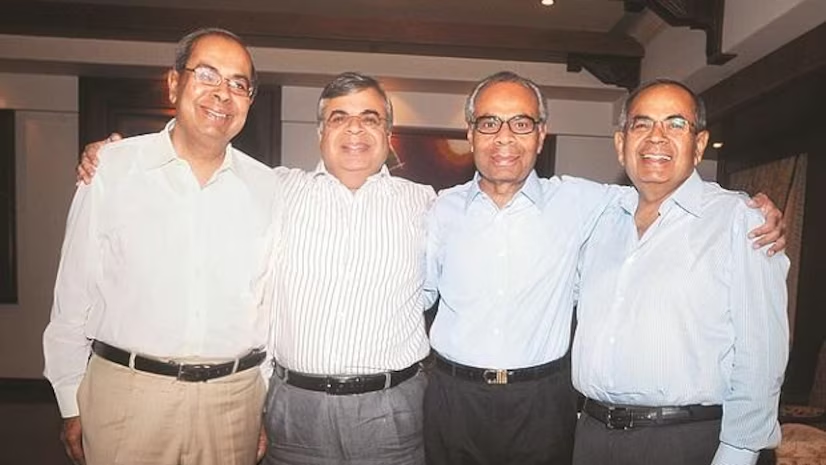
The Hinduja brothers during the era of unified leadership, before the family's internal fractures became public (Photo: Bloomberg)
The patriarch fades and the knives come out
Srichand Hinduja was not just the oldest brother. He was the axis around which the entire empire rotated. His leadership had propelled the Hinduja Group onto the world stage, and his presence alone kept the delicate balance of collective ownership from tipping into chaos.
By the mid-2010s, that axis had crumbled. Diagnosed with dementia, Srichand could no longer manage the daily machinery of a global business. His daughter, Vinoo Hinduja, who had been handling his personal affairs, stepped forward as his advocate, watching over his interests as his cognition deteriorated. But a family that had always governed by consensus suddenly had no mechanism for what happens when the consensus-maker cannot think straight.
Vinoo fired the opening salvo. She accused her uncles -- Gopichand, Prakash, and Ashok -- of systematically shutting out her side of the family from decision-making and control over key assets. The brothers, she alleged, were consolidating power in their own hands, sidelining Srichand and his descendants from the empire he had helped build.
Then the letter surfaced. Dated 2014 and allegedly signed by Srichand, it restated the family credo: "everything belongs to everyone and nothing belongs to anyone." The brothers pointed to it as proof the collective ownership model still held. Vinoo called it a weapon. Her father's mental state at the time he supposedly signed it, she argued, rendered the document invalid -- a convenient piece of paper wielded by relatives who wanted to justify cutting her branch off the family tree. The letter became the flashpoint, two sides telling irreconcilable stories about a single signature on a single page.
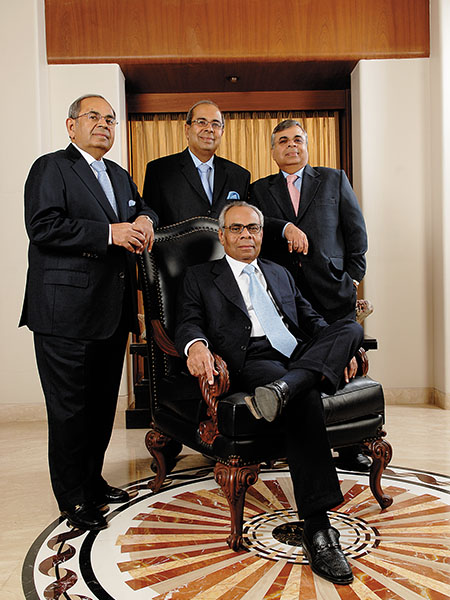
The Hinduja brothers pictured together before the legal battle shattered the family's carefully maintained image of solidarity (Photo: AFP)
Family values go on trial in London
In 2020, Vinoo took her uncles to court. The lawsuit alleged the brothers had acted in bad faith, exploiting Srichand's declining health to seize control of the group's holding companies and financial institutions. For a dynasty that had built its reputation on discretion, the filing was the equivalent of kicking the front door off its hinges.
The courtroom proceedings read like a script pitched somewhere between a Shakespearean tragedy and a corporate thriller. Vinoo accused her uncles of orchestrating a deliberate scheme to isolate her father from the family business and block her from any leadership role. The brothers countered that every move had been made in the best interests of the family, consistent with the Hinduja tradition of collective ownership.
As the case wound through the British courts, the once-impenetrable Hinduja image disintegrated in real time. Media coverage turned the family's vast wealth and sprawling business interests into tabloid spectacle. A clan that had prided itself on unity and privacy was now being dissected on front pages, its internal wounds laid open for public consumption.
The 2022 settlement -- a ceasefire, not a peace
Two years of acrimonious litigation ended in 2022 with a confidential settlement. The precise terms were never disclosed, but reports indicated the parties had reached an agreement on the management of family assets and the future direction of the Hinduja Group.
On paper, it looked like resolution. In practice, it was a tourniquet on a wound that had not stopped bleeding. The settlement extinguished the legal fire but did nothing to rebuild the personal relationships incinerated by years of accusations and counter-accusations. Vinoo remained wary about the fate of her father's legacy and her own standing within the business. Her uncles, meanwhile, pressed ahead with plans for the group, including potential restructuring and global expansion.
For a fragile moment, it appeared the Hinduja empire might hold together. The family had dodged further courtroom exposure, and there was cautious hope that time might do what lawyers could not. That hope had a short shelf life.
Srichand dies and the old wounds reopen
Srichand Hinduja's death in 2023 did not bring closure. It brought gasoline. With the patriarch gone, the balance of power inside the Hinduja Group lurched into uncertainty once more. The succession question -- always simmering, never satisfactorily answered -- boiled over as the remaining brothers moved to tighten their grip on the business.
For Vinoo, the loss was double-edged: personal grief compounded by the disappearance of her most powerful ally. Without Srichand in the picture, preserving her family's position within the labyrinthine Hinduja power structure became an exponentially harder fight. The 2022 settlement had provided a temporary framework, but her father's passing blew new holes in whatever stability it had offered.
Publicly, Srichand's death was met with tributes recognizing the man who had transformed a family trading operation into one of the most successful business empires on the planet. Behind the curtain, the divisions were metastasizing. Insiders whispered that unresolved tensions could trigger another round of litigation -- or, in the worst case scenario, a full fracture of the business itself.
What happens to a $33 billion empire built on a philosophy nobody believes anymore
The Hinduja saga is a case study in the collision between generational wealth and generational change. The Hinduja Group has survived economic upheavals, geopolitical shifts, and decades of global competition. Whether it can survive the people who own it is a different question entirely.
The next generation of Hindujas -- sons and daughters spread across different branches of the family -- will determine whether the empire consolidates or splinters. For Vinoo, the mission is clear: protect her father's legacy while navigating a family political landscape that has proven hostile. For her uncles, the challenge is governing a global conglomerate while managing the ambitions and grievances of relatives who increasingly view unity as a word, not a practice.
The Hinduja Group, with its vast holdings and influence, is not going anywhere. Its $33 billion footprint across banking, automotive, energy, and beyond guarantees it will remain a force in the global business landscape for years to come. But the family that built it is balanced on a knife's edge, the heirs to an extraordinary fortune locked in a struggle over power and control that their founding philosophy was never designed to resolve.
Related Stories
The Redstone Wars: How Shari Outlasted Her Father and Sold the Empire He Built
Sumner Redstone spent decades trying to keep his daughter away from his media empire. She got it anyway — and then sold every last piece of it for $8 billion. Along the way: a son bought out for $250 million, a companion evicted from a mansion, a CBS CEO fired in disgrace, and Donald Trump walking off with $16 million on his way to the White House.
The House of Gucci ran on blood before anyone pulled a trigger
The family that built one of the world's most recognizable luxury brands spent decades tearing each other apart — in courtrooms, boardrooms, and finally, on a Milan street. The murder of Maurizio Gucci in 1995 was the final act of a dynasty that had been killing itself for years.

The Woman Who Tried to Save Her Mother from a Billion-Dollar Con
Liliane Bettencourt was the world's richest woman — and she was being drained of a billion dollars by her best friend. Her daughter went to war to stop it, and blew up French politics in the process.